
























后固化碳纖維復合材料的表面加熱
Ceramicx介紹了一種利用各種紅外發射器在大約15秒內將固化后碳纖維復合材料的表面加熱到235°C的工藝。
查詢
一家一級航空航天制造商要求提交一份報告,詳細說明各種陶瓷紅外發射器對一種獨特的固化后碳纖維復合材料表面進行加熱的能力。目標是使復合材料的表面在大約15秒內達到235°C。復合材料中的環氧樹脂是熱固性塑料,因此,如果溫度過高,就會永久燃燒和變形。
解決方法
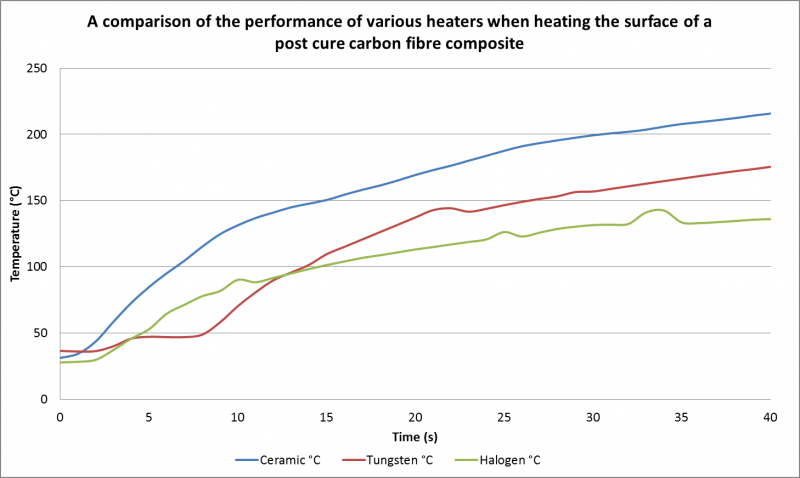
與C平方公里試驗室內的大多數材料測試一樣,初步測試的目的是確定哪種類型的發射器(長波、中波或短波)適合這項工作。在目標距離為100 mm的固定元件上,長波陶瓷元件的性能優于中波鎢和短波鹵素管。
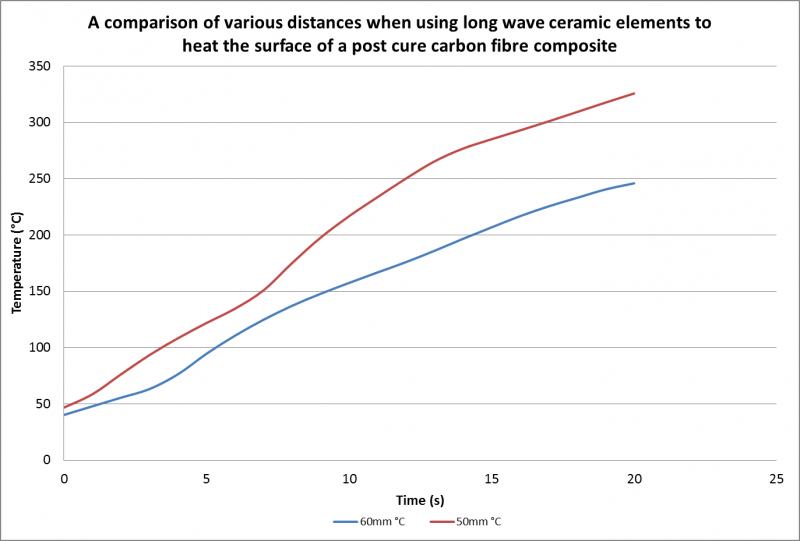
結果表明,加熱元件布置為6x800W黑色SFEH元件,排列在3x2陣列中。根據這一決定,為了達到溫度指標,需要縮小元素與目標材料之間的距離。由于100毫米顯然太大的一段距離,這是減少到60毫米,并反過來50毫米,并注意到結果。
結果
對于所涉加熱元件的布置(瓦特密度為44.8千克/米),復合材料表面的距離為50毫米,可在大約11秒內達到235℃的規定溫度,而且在15秒的時限內很好。
表面吸收熱輻射并將其轉化為熱的能力因材料而異,特別是在復合材料之間。為了大限度地提高效率,在開發一個項目之前,確定適合某一特定材料的合適的發射器是至關重要的。
原文如下: Ceramicx introduces a process to heat the surface of a post cure carbon fibre composite to 235°C in approximately 15 seconds usind various infrared emitters.
Surface heating of a post cure carbon fibre composite
Enquiry
A tier 1 aerospace manufacturer requested a report detailing the ability of various Ceramicx infrared emitters to heat the surface of a unique post cure carbon fibre composite. The target was to bring the top surface of the composite to 235°C in approximately 15 seconds. The epoxy resin within the composite is a thermoset plastic, therefore, should the temperature get too high it would permanently burn and deform.
Solution
As with most material tests within the C?I? test room, the initial tests were to find out which type of emitter (long, medium or short wave) was most suited to the job. At a fixed element to target distance of 100mm, it was found that the long wave ceramic elements outperformed the medium wave tungsten and the short wave halogen tubes.
A comparison of the performance of various heaters when heating the surface of a post cure carbon fibre composite
based on the results, the heating element arrangement used was 6 x 800W black SFEH elements arranged in a 3 x 2 array. Following this decision, the distance between the elements and the target material would need to be reduced in order to reach the temperature target. As 100mm was clearly too large of a distance, this was reduced to 60mm, and in turn 50mm, and the results were noted.
A comparison of various distances when using long wave ceramic elements to heat the surface of a post cure carbon fibre composite
Result
For the heating element arrangement in question (watt density of 44.8 kN/m?), a distance of 50mm was suitable for the surface of the composite to reach the required temperature of 235°C in approximately 11 seconds, well within the time restriction of 15 seconds.
The ability of a surface to absorb thermal radiation and covert it to heat varies between materials, particularly between composites. To maximise efficiency, it is crucial that the most suitable emitter for a specific material is determined before developing a project.